
David gives an update on his artwork: 01
In the last blog post, I describe Psalm 90 and its emphasis on divine authority over life and death, and it is only by God’s mercy we see any good in the world of labor and sorrow. The Psalm ends, “And establish thou the work of our hands upon us; yea, the work of our hands establish thou it.”
As an artist, the final words stand out to me and serve a special role in my work of recent years. Toil is a consequence of inheritance of Adam’s guilt. I can also say that we, as a human race, are a despicable people. All of my work to improve my condition only serves to give me a better looking veneer, and it is the grace of God that makes life meaningful.
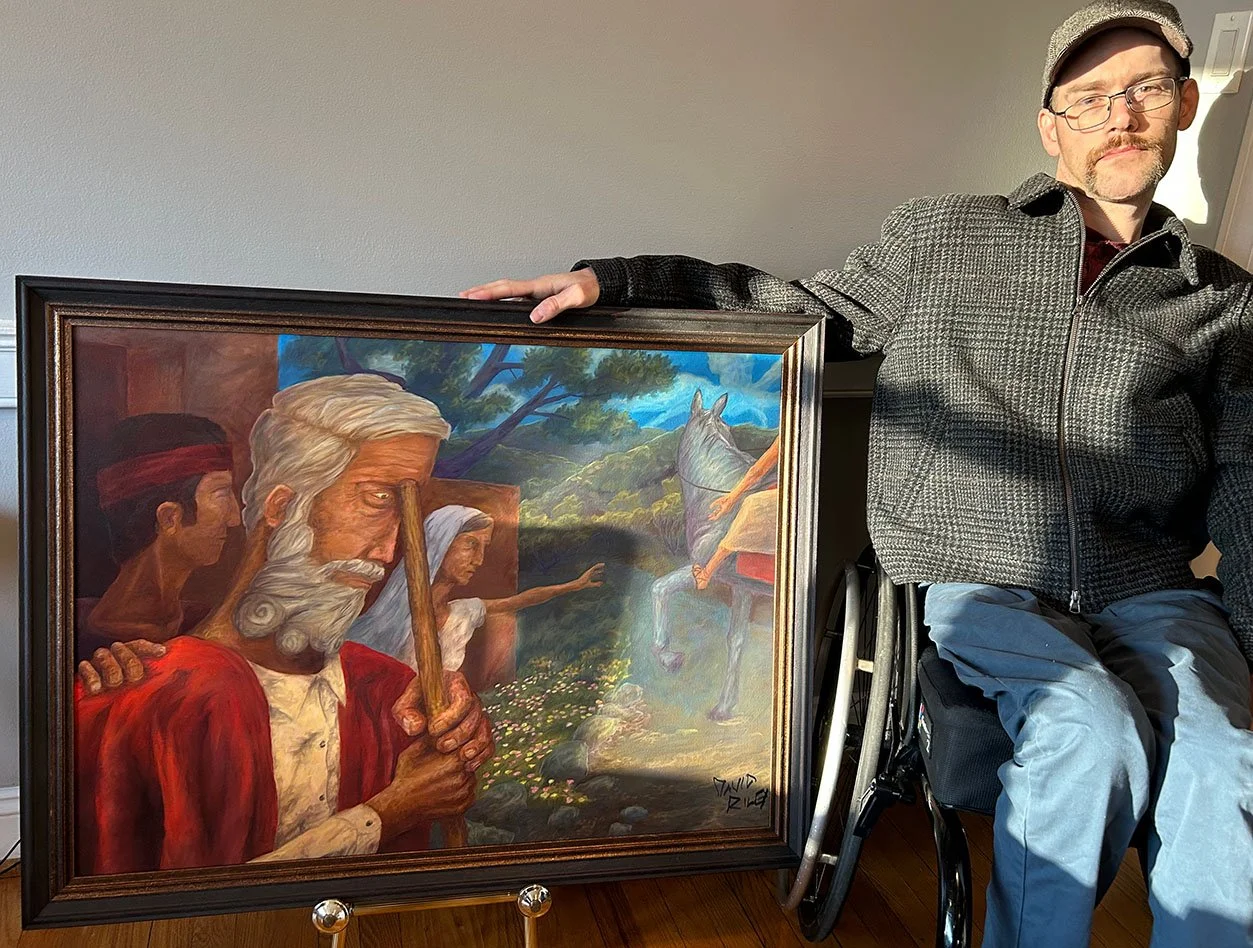
David is next to his most recent painting.
Therefore, labor and the toil therein have meaning and purpose. There is enjoyment found in the process of work. If entertainment, any bodily pleasure, or other kinds of leisure leave, I kindly wave “good riddance.” But it is through enduring toil that one can fulfill God’s initial role for Adam, “to work and serve," and thereby to glorify him.
And the work of my hands is being established. More than five years ago, I was working on some illustrations for a project. I examined the work before me and began to set my gaze on the future. I need my figures to be more form accurate and learn to portray the correct emotional response of them. I need a better approach to mixing and applying color. And I set out to change the habits that caused my work to conform to some undisciplined ways. As a result, there has been growth in the quality and depth of my work.
For a few years now, I have made Jesus’ parables the subject of my work. The art heritage of Western civilization was once directed according to the Word of God as the highest authority. Along the way, art has turned to the course of inner-expression through an emphasis on human authority and the self as an autonomous being. As a result, the Pablo Picassos and Jackson Pollocks have emerged.
Accordingly, the Parable of the Prodigal Son is my current focus. There was a Spanish painter, Bartalomé Esteban Murillo (1618-1682), who painted the parable in a series of five. I said, “Okay, I’ll do six.” Far from arrogance, I recognize my indebtedness to the artists before me. So I did research on different classical artists who painted this particular story and came away with a better grasp of the work before me.
My first of the series of six is The Departure of the Prodigal Son, and I am enabled by the grace of God to maintain the energy I need to progress to making the best work I can. The next update on my artwork will be in March on a bi-monthly basis.
